
Language

- Home
- Product Lineup
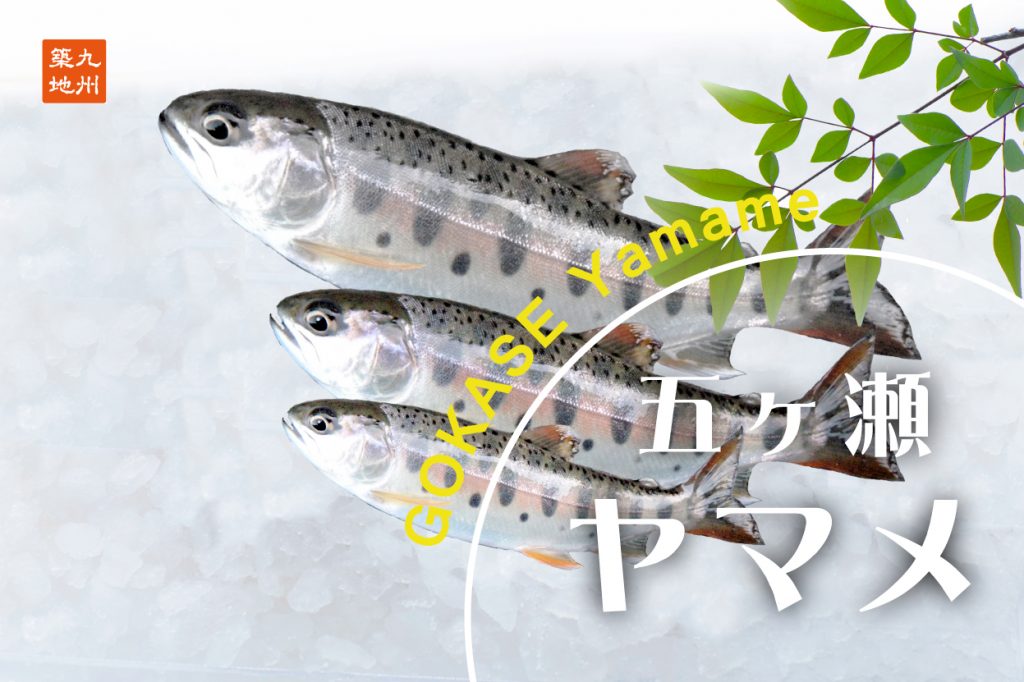
- Gokase landlocked salmon (Oncorhynchus gorbuscha)
Gokase landlocked salmon (Oncorhynchus gorbuscha)
Gokase Town's Japanese pond turtle farm is located 700 meters above sea level, at the headwaters of the Gokase River, deep in the Kyushu Seiryosan Mountains. The farm began in 1963 with the artificial hatching of wild yamame, a native inhabitant of the headwaters of the Gokase River. In 1964, they succeeded in artificial hatching, and in 1967, they succeeded in collecting eggs from the parents of artificially hatched and cultured fish, thereby establishing a cyclical aquaculture system. The farm is located in a disaster-resistant area where abundant groundwater and rich valley water can be used together, and when the valley water used for irrigation becomes muddy, it can be switched to spring water.
In addition, since water temperature and water quality differ between spring water and valley water, the water quality and water temperature environment most suitable for yamame growth can be created depending on the season by changing the mixing ratio. This has allowed us to continue to produce healthy yamame without the use of chemicals, and in recognition of this, in 2007 we became the first freshwater fish to be certified as "Gokase Yamame," Miyazaki Prefecture's No. 6 fisheries brand product.
The most important element in yamame aquaculture is water.
Yamame-no-sato secures as its water source the mineral-rich spring water that bubbles up from beneath the limestone, tuff, and paleosol strata of Aso and the headwaters of the Gokase River, which is recognized as the most beautiful river in Japan.
Completely medication-free, which is possible because of the excellent location.
The fish are raised very close to nature without antibiotics and are the crystallization of the producer's heart.
In autumn, when the leaves are changing colors in the mountain streams, the blistering fireflies begin to spawn en masse, as if they had been watching for the drop in water temperature. During the harsh winter months, they wait patiently in the cold water for spring.
When the water temperature warms up and the wildflowers begin to bloom, they grow one by one, and in early summer, they turn into sprightly newborns...
Enjoy the new pups in tempura, nanbanzuke, grilled with salt, sashimi, meuniere, etc.