Language

- Home
- Product Lineup
- Miyazaki Sturgeon [Completely drug-free
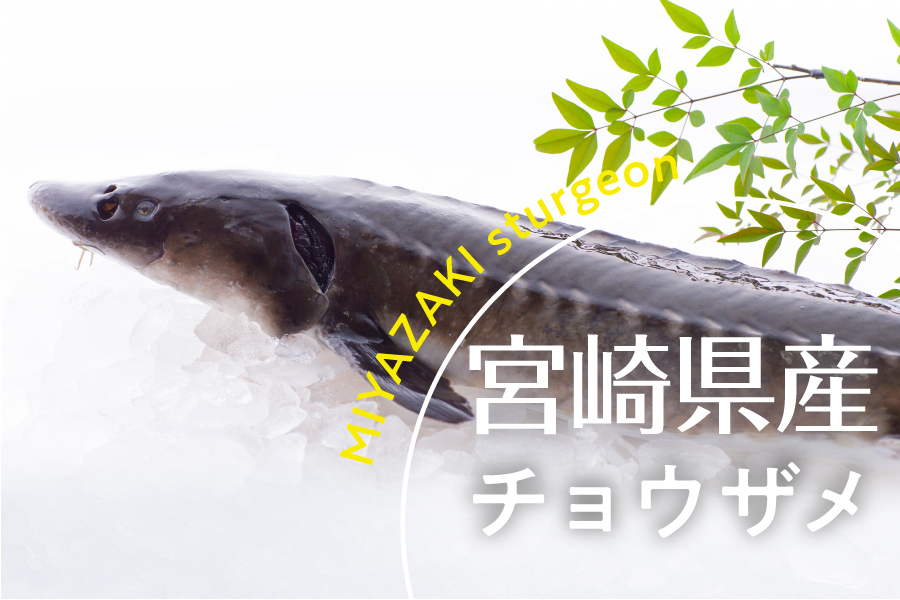
Miyazaki Sturgeon [Completely drug-free
◆Adopted as a hospitality food for the 2023 G7 Miyazaki Agriculture Ministerial Meeting
What is a sturgeon?
 Unlike sharks (fuka), sturgeon haskidneyIt has a Because it can decompose ammonia, it has no odor and has an elegant taste.
and 魚 possessedDHA/EPA (omega-3 fatty acids)とmigratory bird and whalepossessedcarnosine varenineIt combines anti-fatigue ingredients such asIt is one of the most nutritious foods that athletes and the media pay attention to.
Known as "royal fish" in Europe and "emperor fish" in China, it was served to kings and emperors, and was said to be the food of immortality because many of them live for nearly 100 years.
Sturgeon in Miyazaki
 In 2004, Miyazaki Prefecture became the first prefecture in Japan to successfully produce artificial seedlings of white sturgeon.
The most important factor in sturgeon aquaculture is water. Miyazaki sturgeon grows in the mountains surrounded by nature.high proteinThe meat is characterized by its beautiful, clear texture with a Its noble flavor and firm texture can be likened to the taste of a Thai fish and the texture of a blowfish, and the skin has acollagenis plentiful.
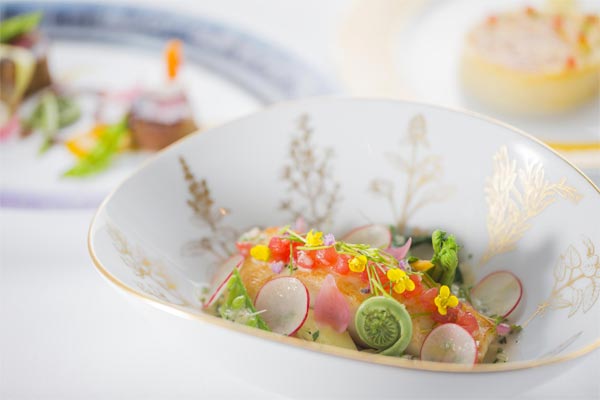
It is highly regarded as an excellent food with high nutritional value that goes well with all kinds of dishes, Japanese, Western, and Chinese.
Eating Supplements
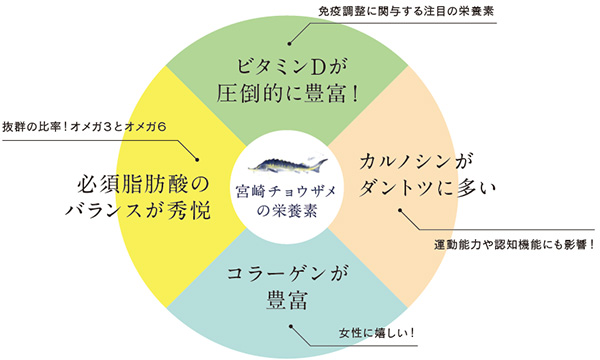
Recent research has shown how nutritionally superior Miyazaki sturgeon is.It was a supplement-like food that contained plenty of nutrients that Japanese people have difficulty obtaining on a daily basis. In particular, it is attracting attention from experts as a food rich in vitamin D, which is involved in maintaining the immune system.
Miyazaki Sturgeon for Improved Immunity!
 Director, Japan Institute of Functional Medicine
Dr. Kozo Saito
However, vitamin D is produced in the skin through exposure to sunlight, and since few foods are abundant in vitamin D, 80% of Japanese who guard against UV rays too much are deficient.
Adults can reach the sufficiency range by taking 50 µg (2000 IU) per day.
Among sturgeon, Miyazaki sturgeon has by far the highest vitamin D content, and it is calculated that 100 g of sturgeon can meet the daily requirement. It is also low in toxic heavy metals, making it ideal for children's nutritional intake.
*About vitamin D units
Currently, the µg (microgram) is the usual unit of weight in Japan, but the IU (International Unit) is also used as a unit of potency.
IU is a unit used for fat-soluble vitamins, especially vitamin D.
For vitamin D: 1 IU = 0.025 µg, 1 µg = 40 IU
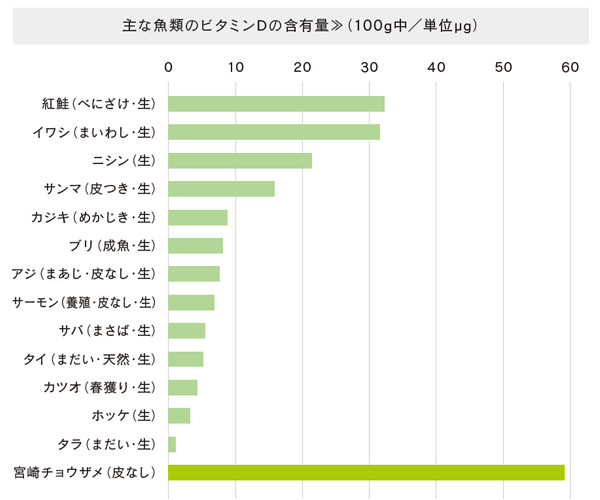
Vitamin D content of fish (other than Miyazaki sturgeon) is extracted from the "Standard Tables of Food Composition in Japan" (2020 edition, 8th revision) by the Ministry of Education, Culture, Sports, Science and Technology.
*The intake of vitamin D
According to the Dietary Reference Intakes for Japanese (2020) by the Ministry of Health, Labour and Welfare, the recommended daily intake (not the amount required to maintain good health) is 8.5 µg/day (340 IU) for adults.
Miyazaki sturgeon can meet that amount with only 20 grams. Incidentally, the Japanese Osteoporosis Society's "Guidelines for the Prevention and Treatment of Osteoporosis (2015 Edition)" states that the required amount of vitamin D is 10 to 20 μg (400 to 800 IU) per day.
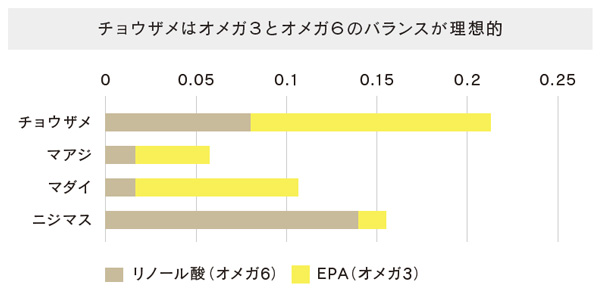
There are two types of essential fatty acids, omega-3 fatty acids and omega-6 fatty acids, and in recent years there have been whispers that too much omega-6 fatty acids are being consumed.
Omega-6 fatty acids are the kind of oil that enters the mouth without saying a word, and because of their inflammatory effects, too much of them is thought to promote allergies and other inflammatory diseases.
Omega-3 fatty acids, on the other hand, have been found to have the opposite effect, directly inhibiting inflammation.
This is why foods high in omega-3 fatty acids are attracting so much attention.
And the content ratio of omega-3:omega-6 is important.
As in sturgeon, a 2:1 balance with high omega-3 fatty acids is very ideal.
carnosine
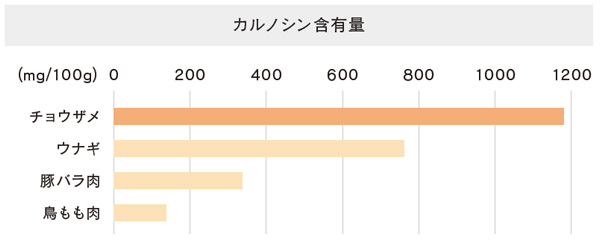
Because it is also involved in athletic performance such as human endurance and instantaneous force, it is often found in applications used by athletes.
In recent years, the relationship with cognitive function has also become clearer.
Miyazaki sturgeon, due to its unique diet, also has a significantly higher carnosine content than other fish.
collagen
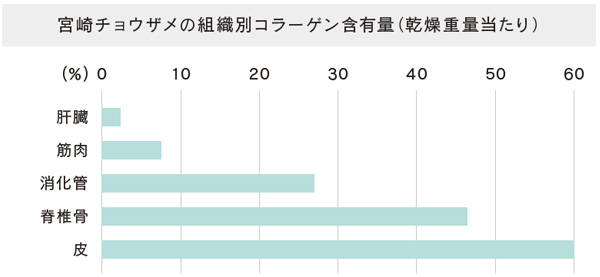
Collagen is abundant in the skin of fish, and sturgeon is no exception.
More than 60% of the skin is collagen.
Don't throw away the crunchy skin.
Sturgeon is said to have "nothing to throw away," and the whole fish can be enjoyed as a whole: the middle bone can be fried, the entrails and gills can be used for tempura, and the head can be used for soup.
Long-lasting taste!
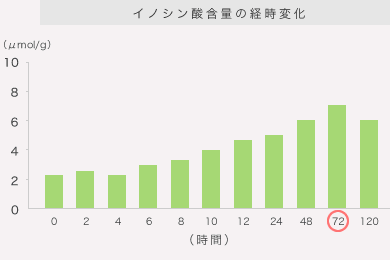 Miyazaki sturgeon is a fish that keeps well fresh.
Adenosine triphosphate, which is said to improve blood flow and the function of organs and muscles, disappears in about 12 hours in horse mackerel and chub mackerel.
Miyazaki sturgeon, however, remain after 120 hours, or five days.
The K value, an indicator of freshness, is less than 20 at 72 hours (3 days) after being fresh-finished, and is still 30 at 120 hours (5 days), indicating that the freshness is maintained for a long time.
In addition, IMP (inosinic acid), a flavor component, increases with time, with the highest value after 72 hours, making it the most delicious. (Stored at 4°C)